Czecholsovakian Pottery kimlovesczech.blogspot.com

Saturday, March 17, 2012

My Expat life in Barcelona

Barcelona
I was very fortunate to be able to live in Barcelona as an expat for a little over two years. My husband, Richard worked for a multinational corporation which relocated us there for a while. My sons came over for extended visits, soaking up the culture. We all appreciated our time there.


One of the best parts of Barcelona is just walking around the city admiring the architecture. I loved the Catalan Modernism. I am woefully uneducated on this topic, but you can find plenty of information on the subject. The most well-known Modernist architecture in Barcelona is the handiwork of Antoni Gaudi (1852-1926), and after seeing his work in person, I’m convinced this man was a truly gifted and visionary architect. During my time in Barcelona, I repeatedly toured many of Gaudi’s works and also saw the works of some other gifted architects. I absolutely fell in love with the distinctive architecture of Barcelona.


Here are some examples of Catalan Modernism to be found in the city:
La Sagrada Familia
Located at Mallorca 401, or take Metro: Sagrada Familia. This is Antoni Gaudi’s masterpiece, although it still isn’t finished, long after his death. You can enjoy the exterior of the cathedral from the street for free, but I highly recommend the tour of the building. If you think the outside is impressive, wait until you get a look at the inside. It is the most beautiful and unique cathedral I’ve ever seen. The bus Turistic, hop-on, hop-off bus, is the best way to sight-see your way around Barcelona.


Parc Guell
Located at d’Olot, 3, or take Metro: Lesseps, but it is still a long walk from there. Admission is free. But take your time getting up the steep hill. On one of my first visits to Barcelona was during spring break before we moved there and we hiked up to Parc Guell, through a back way. The Parc is itself lovely, but also commands some great views of Barcelona. This is another work of Gaudi’s.


Parc Guell unfolds in levels. Every time I walked up another level, I thought I was at the top, but no, there was yet another level to climb. I never did make it to the top before giving up. There are lovely wildflowers and structures and views; there are living statues and flamenco dancers and people selling trinkets. I thought it was interesting that the restrooms and cafe kitchen were built into the side of the hill in caves. There is a patio here with tables and umbrellas overlooking a dirt plaza where you can enjoy a cold drink and a bite to eat while people-watching.
Casa Mila (a.k.a. La Pedrera)
Located at Passeig de Gracia #92 or take the Metro: Diagonal. This is one of two spectacular Gaudi buildings along the Passeig de Gracia. There are metro stops along this lovely avenue, but I walked it many times, and I would recommend that to anyone in reasonably good health if the weather is nice. I started at Placa Catalunya and walked up to La Pedrera and back. There is a gallery with free admission where you can see rotating art exhibits.

Casa Batllo
Located at Passeig de Gracia #43, or Metro: Passeig de Gracia. I expected to like La Pedrera more than Casa Batllo, but when I saw them in person, it was the other way around. This building is just endlessly fascinating.


The Palau de la Musica Catalunya
Located at Carrer Palau de la Musica 4-6, just off Via Laietana in the Barri Gotic section of Barcelona, or take Metro: Urquinaona. This masterpiece was designed by Domenech i Montaner and is a UNESCO world cultural heritage site.
The one absolute must for nightlife in Barcelona is a concert at the Palau de la Musica Catalana. Stop by the hall during the daytime to buy tickets at the box office and also to by tickets for a guided tour in English during the day. The acoustics of the hall are superb. We saw Jackson Brown with David Lindley there, and another concert featuring Anoushka Shankar.


Torre Agbar
Located at Avinguda Diagonal 209-211, or take Metro: Station Glories. This uniquely-shaped building is so prominent on the Barcelona skyline that you really can’t ignore it. By all reports, the architect was aiming to evoke the sense of a water fountain with this building, but every time I saw it, I thought “Oh yes, there’s the giant phallic symbol.” The building, which houses the Barcelona water company, is illuminated with color at night.


Besides architecture, the was the Beach and other areas
To photograph people enjoying the beach, start in Barceloneta, a complex of narrow streets and houses built for the working class. The district is surrounded by a yacht harbor on one side and a sandy beach on the other. There is a covered market in the main square. Barcelonans predict rapid gentrification of this district but in the meantime you can get some photos of old neighbors hanging out laundry and chatting.
We lived in Sant Marti and only had to walk over a bridge to get to the beach. It was wonderful in the summer, I especially liked going for drinks and tapas on the beach. Music would blare out from the beach huts, and it always looked like a party in the height of the summer. My sisters enjoyed going to the beach for an outdoor massage.


La Rambla
One of the most famous streets in Spain, La Rambla runs through the Old City right down to the harbor. The wide center strip is devoted to newsstands, flower merchants, performers, and hordes of pedestrians. On either side of this strip are busy lanes for cars and buses.


One day Michael and I traveled to the city center from the train station in Mataro,while we were living in the NH Hotel. We got off at the center of the city and I saw this square called Plaza Catalunya in front of my eyes, it was then when I realized that I was in for a true adventure. My dream of living in one of the jewels of Europe had come true. I was very excited and wanted to get to see everything.


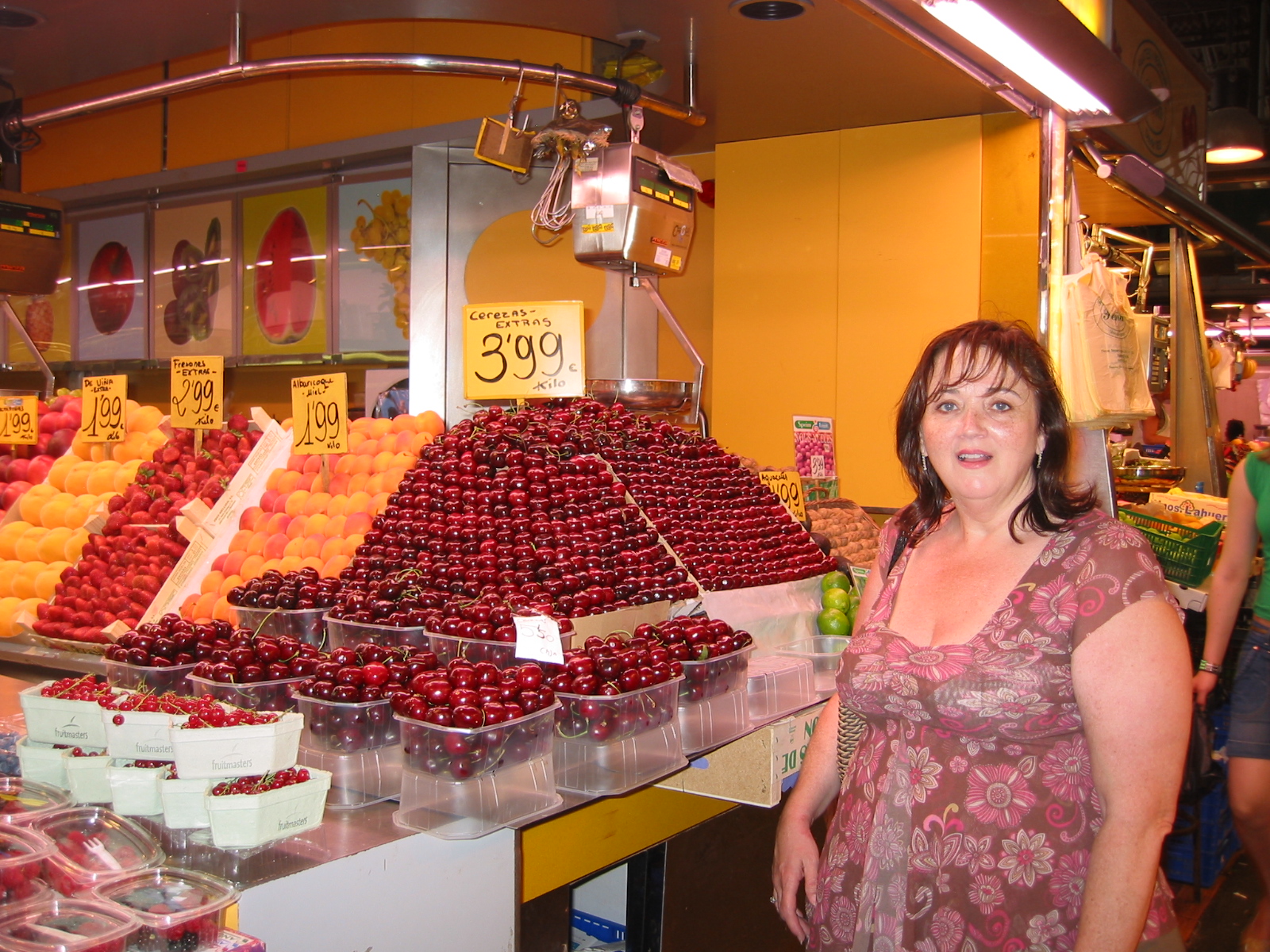
We started walking down Las Ramblas which was so crowded… What struck me the most was the beauty of the place and the buildings on both sides of the famous avenue. On the right, the market of La Boqueria was inviting me to enter and see its stalls with the most colorful, fresh fruit and vegetables. At special times during the year, parades would travel down side streets of the Ramblas.


The buildings were not the only things on the Ramblas that caught my attention. There were loads of street performers, stallholders, peddlers and painters in this emblematic avenue of Barcelona. I could feel the lively ambiance in Las Ramblas, and noticed that having a walk along this street was one of the best things to do in Barcelona. The human statues were very impressive but they do want to be paid, especially if you take their photo.


One area off the Ramblas I love to walk through is the Placa Reial. I loved walking along the narrow streets in the Gothic quarter. Everyday was an adventure in Barcelona, I really miss my time there!


- Posted using BlogPress from my iPad

Friday, March 16, 2012

Dubrovnik, the pearl of the Adriatic

Dubrovnik is the most famous coastal city of Croatia, its medieval old town will impress everyone that walks into the city’s great wallsI certainly enjoyed my visit there.

For centuries Dubrovnik was the biggest rival of Venetian republic in the Adriatic coast. Dubrovnik has always been big in trade due to its location near the sea, which contributed to most of its wealth. During the middle ages, the city of Dubrovnik became a competitor and a rival for Venice. The city had good numbers of skilled labor and money and as a result of which, saw enormous growth during the 15th and the 16th century. The city was also a home for notable poets, painters, politicians, play writers and scholars. In the late 18th century both Dubrovnik and Venice were met with the same ending – Napoleon.


Dubrovnik attracts thousands of tourists every day but fortunately it managed to keep its unique atmosphere and its local life.


Patrick on the Stradun nearS t Blaise 


My adventure into Dubrovnik was with my son, Patrick. We were there on a Mediterranean cruise. We enjoyed our stop to simply explore the city. The beauty is just extraordinary and only enhanced by the uniqueness of it all. Dubrovnik is unlike any other city in Europe. Reflecting back on it now the one element that comes to mind when I think if Dubrovnik is the cleanliness of the city.


Dubrovnik is famous for roaming destinations like Roland’s Column, the Bell Tower, the Sponza Place, War Photo Limited, Pile Gate, and some famous churches and museums.


Right in front of the Pile Gate entrance is the circular Onofrio Fountain built in the 15th century and sporting 16 carved masks. Unlike the rest of Dalmatia, Dubrovnik citizens were not relegated to capturing rainwater; the fountain was connected by aqueduct with a spring near the town. 


Patrick at Onofrio Fountain


The Church of St Blaise (Crkva Sv Vlaho) is Dubrovnik's most beloved church, partly because St Blaise is the patron saint of Dubrovnik. Most festivals in Dubrovnik begin or end or have something to do with this church, conveniently located at the eastern end of Stradun. A recent restoration left the facade gleaming and the stairs are a perfect resting place for bedraggled tourists.


Stylistically, the church is stately but with welcoming ornamentation that pleases the eye without overwhelming the surroundings. The Venetian architect Marino Gropelli oversaw the church's construction which was finished in 1715. It was built on the site of an earlier church that was destroyed in a fire several years earlier. The only surviving remnant of that church was a 15th-century statue of St Blaise who holds a model of medieval Dubrovnik in his hand.The statue is now incorporated into the main altar. Also saved were two stone figures of saints made by Nikola Lazanic from Brac at the end of the 16th century.


Watercolor of  St. Blaise purchased in Dubrovnik


The Stradun is the main street of Old Town. It runs from the Pile Gate on the west to Ploce Gate on the east. The paving stones were laid in 1468.


Dubrovnik's old city walls run over a mile around the city. Walking on the city walls is a popular tourist activity.


The city walls complete with turrets, towers and staircases were constructed in the 10th century and fortified in 1453. The walls are 4 to 6 meters thick (13 to 20 ft) on the landward side but are much thinner on the seaward side.


Old Town Dubrovnik is entirely pedestrian so walking is the only way to get around.


Many of the little streets north of the Stradun rise up in seemingly endless stairs.


Dubrovnik was heavily bombed during the Croatian War of Independence from 1991 to 1995. Almost all of the damage has been repaired; however, if you look closely around the old town, mortar damage in the cobblestone streets and bullet marks in the stone houses are visible.


- Posted using BlogPress from my iPad

Saturday, March 10, 2012

Anthropologie

Why do I like Anthropologie so?

I love a home that is filled with things that are basically a snapshot of a homeowner's life. By looking at their accessories you get a glimpse of who they are, their things tell a story! I get that feeling at Anthropologie, like someone has traveled the world and collected a variety of things they found interesting, humorous, or meaningful. The sentimental, the quirky, the reinvented, the antique and the memorable — all are displayed.

Our life experiences should flow through our homes. At Anthropologie you can see ways to break out of the expected, predictable and delve into the unique and interesting. Here you can find unique ways to express your life through accessories.

Anthropologie does a great job grabbing your senses to create a wonderful ambience. From their eye catching displays in old weathered furniture, textiles that make you want to reach out and touch them, to delicious smelling candles filling the air, and designs that evoke your grandmother's things. Anthropologie has the ambience thing down to a tee. It feels like a personal and creative home you could really enjoy spending time in.


I especially like their a animal plates that were on display during my recent visit. I love the style and the colors.
Posted using BlogPress from my iPad

Sunday, March 4, 2012

Alhambra

Alhambra
A Mediterranean cruise afforded my son, Patrick and I with an opportunity to visit the Alhambra in 2007. When Patrick and I arrived in Granada our excursion took us straight to the Alhambra. It was very interesting to see this elaborately decorated palace. I have interest in Spanish history, since living in Barcelona for several years.


Why visit the Alhambra?
Firstly the location is absolutely breathtaking – set against the backdrop of the Sierra Nevada mountain range of Spain. Alhambra can be seen for miles around.  Translated as “The Red Fortress” in Arabic, due to the colour of its walls, The Alhambra of Granada, one of the best preserved Arabian palaces of its era, is alive with history and romance.  It has inspired poets, writers and artists for centuries, including Washington Irving’s ‘Tales of the Alhambra’, written in 1832.


Where is the Alhambra?
The Alhambra palace and fortress complex is located on a hill named al-Sabika, on the south-eastern side of the city of Granada, overlooked by the awesome Sierra Nevada mountain range, Granada is situated in the South of Spain in AndalucĂ­a.


What Is The History of Alhambra?
There are Alhambra references  from the ninth century onwards, the Alhambra was originally the capital city of a series of city-fortresses intended to protect the last Muslim state in the Iberian Peninsula.


The current complex, including the palace, however, was built in the middle of the fourteenth century during the Nasrid dynasty, as the residence of the Muslim emirs and their court, and is ornately decorated according to the styles of that period; featuring intricate details such as carved cedar-wood and delicate mosaics.

The significance of Granada to Moorish history in Spain is tremendous. Granada was the very last stronghold of the Moors in Spain when in 1492 it fell to Ferdinand and Isabella, marking the very end of almost 800 years of Muslim rule in Iberia. Upon completing the Reconquista, Ferdinand and Isabella presided on their throne from the Alhambra, where Christopher Columbus had his audience for the financing of his voyage West.

After the Catholic Monarchs (Ferdinand and Isabel) conquered AndalucĂ­a in 1492, parts of the Alhambra were used by the Christian rulers, and eventually the mosque was replaced by a church.  In 1527, the palace of Charles V was built within the complex as a permanent residence for the Monarch. Eventually the complex fell into disrepair, inhabited by vagrants, and even being used as soldiers’ barracks during Napoleonic times.


For several centuries it lay abandoned, until being declared a national monument in 1870.  Alhambra palace was designated a UNESCO World Heritage Site in 1984.  Now, it is the most popular tourist attraction in Spain, with over 2 million visitors a year.


Richly coloured tiles, delicate sculptures and unique Arabic artwork…. Courtyards filled with cypress trees and flowers, set among cool ponds and fountains…… Walls lavishly decorated with Arabic calligraphy and poems…. Imposing towers, palaces fit for a king, and sumptuous gardens.  The place was absolutely gorgeous: luscious gardens, breath-taking views over the city of Granada, and impressive Arabic architecture. The massive structure was also very cool because it featured signs of Arabic science, the most visible being the water system that flowed through the Alhambra. The Palaces of the Nazaries were astonishing palaces that featured beautiful water fountains and The Generalife garden was just as amazing as the Alhambra.

Overlooking the Alhambra, the Generalife has a picturesque view of Granada. The garden featured a maze of greenery that canopied over us. The water fountains and ponds added to the beauty of the luscious Generalife. The grounds featured a type of waterfall,  with a stream of water flowing down a staircase in the Generalife. Our guide explained to me that the Generalife was designed by the Muslims to resemble Heaven, or paradise. She also said that the numerous palm trees in Granada were a symbol of paradise. The Generalife was definitely a very peaceful and breathtaking place to visit.

One can see all the three elements of Islamic art in the Alhambra:  geometrical patterns, vegetal patterns, and Arabic calligraphy. The calligraphy is simple stuff and is just two words, literally, Help and God.  The Alhambra may be the most inscribed building in the world. There may be no other building that has the word God or Allah inscribed on it as many times as in the Alhambra.


 The last Muslims rulers of Spain, the Nasirids, were well aware of their position and decorated the Alhambra fittingly: imploring God for His help and protection. Everyone interprets the Alhambra as royal palace, a secular place, but it is a masterpiece of the Sufi artists and a significant piece of Islamic religious architecture and decoration. The Nasirids held on until 1492 and the years that followed saw the holocaust of Muslims in Europe. 


The internal courtyards of the Alhambra, some of them separating parts of the building constructed at different periods, throw the interior open to light.

The gardens are particularly beautiful and relaxing, with pretty flowers, fountains and ivy-covered walls. We walked around the Generalife Gardens, and visited the Nasrid Palaces.  Dome of the Hall of the Two Sisters – Most impressive and recognizable architecture element of the hall is the dome of mocarabes, a decorative element present throughout the monument.
In the month of December, the Alhambra gardens look winter bare in some places.

Our tour guide brought cat food to feed the strays that live here.
Princesses, often locked up in a lofty tower by their fathers to stop them from  communicating with unsuitable young men! No longer at place to lock up their daughters, many choose the Alhambra as a place for their wedding.  We we were there to catch a bride and groom getting ready to take their wedding photos.


There is much that can be said about the Alhambra, but there is also a magic in finding out for yourself about this amazing place.  It is a place of exquisite beauty and I will always treasure my visit there.